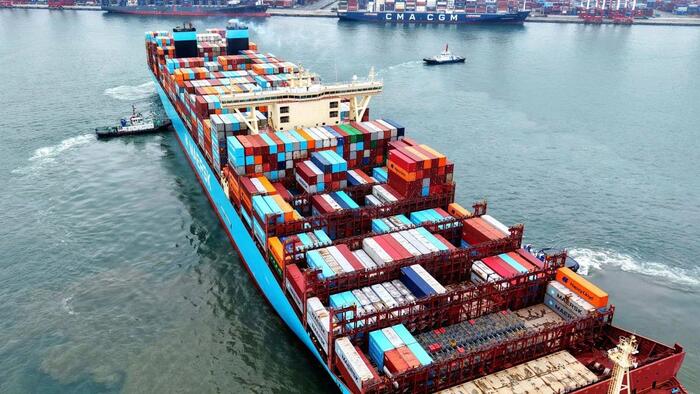
The Trump administration has officially declared that Chinese exporters have been orchestrating a massive scheme to sidestep U.S. tariffs, labeling the operation “The Great Transshipment Scam.” In a sharply worded 25‑page report released Thursday, officials allege that Chinese firms have been routing goods through more than 40 third‑country hubs—particularly Vietnam—to exploit lower tariff rates and disguise the products’ true origin.
A Long‑Standing Practice Uncovered
The document confirms suspicions that have circulated since the trade war began in 2018. It states that exporters routinely employ limited assembly, relabeling, repackaging, re‑invoicing, and false country‑of‑origin claims to mask Chinese origin and secure more favorable tariff treatment upon entry into the United States. The White House notes that this practice has “increasingly routed goods through third countries … where limited assembly, finishing, repackaging, relabeling or documentation changes could create the appearance of a different national origin.”
Peter Navarro, the White House senior counsellor for Trade and Manufacturing, described the scheme as a “great transshipment scam” that has “laundered China’s exports through more than 40 countries, robbing our treasury of tens of billions of dollars, and stealing the paychecks of American workers.” He added that the report “rips the mask off.”
Global Participants
The report lists 40 countries implicated in the transshipment network, including major U.S. trading partners such as Canada and Mexico, as well as allies like Japan, South Korea, the European Union, and Israel. Most Southeast Asian nations appear on the list—Indonesia, Malaysia, Thailand, Vietnam, Singapore, Cambodia, Laos, Myanmar, and the Philippines—alongside South Asian countries India, Bangladesh, and Sri Lanka.
Economic Impact Estimates
Citing a range of third‑party estimates, the report estimates the annual value of goods involved in illegal or suspect transshipment to fall between roughly $40 billion and $303 billion. Using a midpoint figure of $75 billion per year, the administration projects that about 450,000 American jobs may have been displaced and up to $150 billion of U.S. GDP could have been lost. These figures are presented as model‑based illustrations rather than hard counts.
Applying illustrative tariff rates of 25% to 45%, the report estimates that U.S. revenue losses could reach “tens of billions of dollars” annually.
China’s Response
The Chinese embassy in Washington has condemned the report, arguing that the U.S. is “overstretching the concept of national security” and using state power to suppress Chinese enterprises. Embassy spokesperson Liu Chang warned that any unilateral actions targeting transshipped goods must not harm the interests of third parties. He added that China would take “necessary measures to safeguard its legitimate rights and interests” if such actions proceed.
Future Enforcement
The administration plans to deploy artificial intelligence tools—an initiative dubbed “Detective Border”—to monitor trade flows and identify transshipped goods more effectively. The report arrives amid ongoing tit‑for‑tat economic measures between Washington and Beijing, just a month before Chinese President Xi Jinping is expected to visit the United States for a leader‑level summit with President Donald Trump.
Closing the Tariff Loophole
Washington’s latest report arrives at a time when the United States is tightening the rules that have long been exploited to sidestep tariff duties. The administration is pursuing a comprehensive strategy to eliminate what it sees as a major gap in its tariff regime, a move that dovetails with the broader “Detective Border” initiative designed to track trade flows and flag transshipped goods.
Mexico Comes Under the Spotlight
Mexico has become a focal point of the scrutiny, largely because of its free‑trade agreement with the United States and the growing influx of Chinese investment and components into Mexican factories. These developments have placed Mexico at the center of the ongoing joint review of the United States‑Mexico‑Canada Agreement (USMCA). Washington has declined the automatic 16‑year extension of the pact, citing a range of concerns that include the issue of Chinese transshipment.
In a recent statement, Deputy Secretary of Commerce Alan Navarro described Mexico as “one of the biggest transshippers,” arguing that China leverages the USMCA tariff rates of nothing and “sneak stuff in.” Navarro added that “Communist China has engaged in an extremely sophisticated set of actions that are designed essentially to transship and thereby evade the tariffs.”
Estimated Scale of the Problem
An analysis by the Coalition for a Prosperous America, a lobbying group representing U.S. manufacturers, estimated that roughly US$14 billion of Chinese trade was diverted and transshipped to the United States following the 2025 tariff escalation, with ASEAN countries accounting for the majority of that volume.
Expanding Anti‑Transshipment Measures
Washington has already begun to tighten its tariff framework. A 2025 framework agreement with Vietnam imposes a 40 percent tariff on goods identified as transshipped, double the rate applied to ordinary Vietnamese‑origin shipments. Similar anti‑transshipment provisions have been incorporated into other bilateral arrangements and executive actions aimed at curbing indirect shipments.
Asian manufacturing hubs such as Vietnam and Thailand are also facing increased scrutiny. Trade data released earlier this year revealed a gap of about $112 billion between China’s reported exports to the United States and the arrivals recorded by U.S. Customs and Border Protection—a discrepancy widely interpreted as evidence of large‑scale tariff circumvention.
The Administration’s Response
While the report concludes that “it is too early to determine the net effect of the Administration’s tariff and anti‑transshipment policies,” it underscores that the tariff pressure remains intense. In July of last year, an executive order extended a 40 % penalty tariff to goods that U.S. Customs and Border Protection determines were transshipped to evade duties. The penalty is levied on top of any country‑of‑origin tariff, and the administration has begun publishing lists of countries and facilities linked to suspected tariff evasion schemes.
The White House release followed a letter from Senator Bernie Moreno, a Republican from Ohio, urging Homeland Security Secretary Markwayne Mullin to intensify the crackdown. In an August 12 letter, Moreno described the practice as “a deliberate scheme by foreign manufacturers, overwhelmingly based in China, to falsify where their goods are made, launder them through a third country, slap on a new label and dump them into the American market.” He specifically pointed out that Chinese auto parts routed through Thailand had adversely impacted manufacturing in Ohio.