Treasury Liquidity Boost and Dollar Weakness
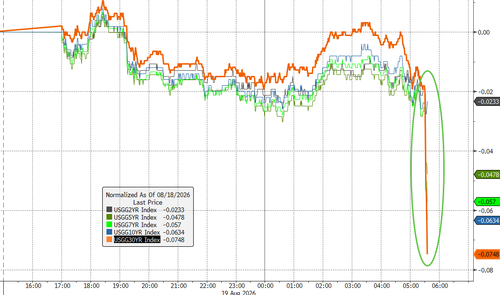
On Wednesday, the U.S. dollar index fell to its lowest level in about 2½ months, ending the session down roughly 0.8%. The move came after the Treasury disclosed that it will at least double the ceiling on its liquidity‑support buyback programmes for longer‑dated nominal coupons, setting a new minimum size of $4 billion per operation beginning 9 September. The announcement, together with a dip in Treasury note yields, narrowed the interest‑rate advantage of the dollar.
The minutes from the Federal Open Market Committee meeting held on 28‑29 July showed a mildly hawkish tone. Several officials warned that further tightening could be required if inflation does not ease, describing the inflation outlook as “highly uncertain” and noting that the ongoing conflict in Iran added to the uncertainty. Nonetheless, the labor market was portrayed as balanced, with demand matching supply. Market pricing now reflects about a 32 % chance of a 25‑basis‑point rate increase at the next FOMC meeting scheduled for 15‑16 September.
Currency Market Reactions
The euro benefited from the dollar’s decline, climbing about 0.84% to reach a 2½‑month peak against the greenback. The rally was reinforced by the Treasury’s liquidity move, although a simultaneous rise in crude oil to a three‑week high exerted downward pressure on the euro, given Europe’s reliance on imported energy. Traders are currently assigning a 96 % probability to a 25‑basis‑point hike by the European Central Bank at its 10 September policy meeting.
The yen also appreciated, gaining roughly 0.8% and touching a one‑week high versus the dollar. The currency’s rise was supported by stronger-than‑expected Japanese core machine‑order data for June and the lower U.S. Treasury note yields. However, the surge in oil prices, which benefits Japan’s import bill, acted as a bearish factor. Bloomberg reported that Prime Minister Sanae Takaichi’s administration backs a Bank of Japan rate hike in either September or October, a stance intended to curb yen weakness and keep inflation in check. Combined with recent coordinated U.S.–Japan foreign‑exchange intervention, markets are pricing a 67 % likelihood of a 25‑basis‑point BOJ hike at the 18 September meeting. The BOJ’s policy rate remains at 1.00 %, well below the Federal Reserve’s 3.50‑3.75 % target range, leaving the yen with a relatively weak interest‑rate differential.
Precious Metals Rally
Gold prices surged, with the October COMEX contract closing up $123.50 (about 2.81%) and reaching a two‑and‑a‑half‑month high. Silver also posted gains, the September COMEX contract rising $1.788 (approximately 2.79%). The dollar’s slide acted as a tailwind for both metals, while the Treasury’s expanded bond‑buyback programme heightened demand for safe‑haven assets. Lower global bond yields further underpinned the rally.
On the downside, the jump in crude oil to three‑week highs revived inflation concerns, potentially prompting central banks to tighten policy—a factor that could weigh on precious‑metal prices.
Fund Flows and Central‑Bank Demand
Recent fund activity has introduced some bearish pressure. Long positions in gold exchange‑traded funds fell to a 10.25‑month low on 27 July after peaking at a 3.5‑year high on 27 February. Silver ETFs showed a similar pattern, slipping to a one‑year low on 14 July from a 3.5‑year high recorded on 23 December.
Conversely, central‑bank demand for gold remains robust. Data released on 7 August indicated that China’s People’s Bank of China increased its gold holdings by 640,000 ounces in July, bringing the total to 76.08 million troy ounces—the 21st consecutive month of net additions.
Outlook
The dollar’s recent weakness, driven by Treasury liquidity actions and softer Treasury yields, appears to be supporting risk‑off assets such as gold and silver. Currency markets remain sensitive to upcoming policy decisions from the Fed, ECB and BOJ, while oil price dynamics continue to influence both inflation expectations and the relative attractiveness of safe‑haven assets. Investors will be watching closely for any further coordination between the United States and Japan on currency intervention, as well as for the impact of central‑bank reserve adjustments on metal demand.