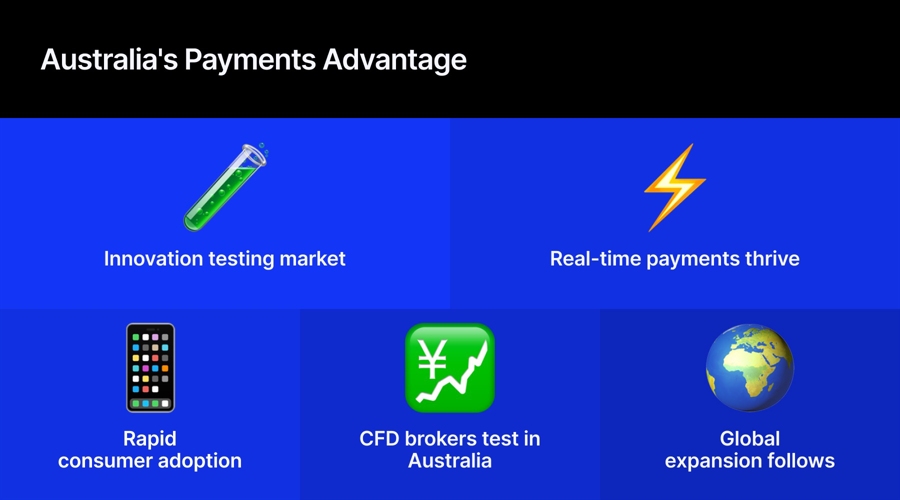
Australia’s reputation as an innovation playground has expanded beyond software giants to become a proving ground for payment technology. With a population of roughly 28 million, the country offers a market large enough to generate actionable insights yet small enough to experiment without the high stakes of a global rollout. This unique balance has attracted major CFD and online trading platforms, which are now using the Australian payments ecosystem to test and refine customer experiences before launching them worldwide.
A Compact, Yet Insightful Market
The Australian demographic profile mirrors that of many leading Western economies, but on a reduced scale. This makes the market ideal for piloting new payment solutions: firms can observe real‑world usage, tweak features, and manage risk before expanding to larger territories. Global traders such as Pepperstone and Trade Nation are already leveraging this environment to validate innovative payment experiences.
Lightning‑Fast Adoption of Contactless Payments
According to the latest Consumer Payment Survey by the Reserve Bank of Australia (RBA), contactless payments dominate in‑person transactions, rendering cash almost obsolete. The Australian Banking Association reports that citizens conduct more than 500 million mobile‑wallet transactions each month, with a combined value exceeding $20 billion. The speed of this uptake is striking: after initial trials in 2011, Australia achieved widespread contactless usage by 2018. A coordinated rollout of “tap‑and‑go” infrastructure by major banks, paired with enthusiastic merchant participation, accelerated the shift away from physical currency faster than many comparable markets.
Real‑Time Account‑to‑Account Payments with PayID
PayID, a real‑time account‑to‑account payment system that allows users to send money using a mobile number or email address instead of traditional bank details, is mirroring the rapid adoption seen with contactless technology. The RBA survey indicates an 18 % increase in PayID usage in 2025, with about half of respondents reporting they had used the service at least once in the past year.
Demand for 24/7 Funding in CFD Trading
For traders, the speed and flexibility of fund movement are as critical as the trading platform itself. Volt’s data reveals that nearly 73 % of CFD account top‑ups via Australia’s New Payments Platform—including PayID and PayTo—occur outside regular 9‑to‑5 banking hours, and 21 % happen on weekends. These numbers underscore that traders prioritize the ability to fund their accounts whenever market opportunities arise, rather than being restricted by traditional banking schedules.
Global Platforms Embrace Australian Real‑Time Payments
In response, international brokers such as Trade Nation and Pepperstone have integrated real‑time payments through Volt for their Australian clientele. Trade Nation’s Payments Manager, Siona Spooner, notes that Australian consumers adopt new payment methods more rapidly than those in many comparable markets, making the country an ideal testing ground. Early data supports this approach: 47 % of CFD traders using the New Payments Platform are repeat payers, with two‑thirds returning within a week and more than a quarter topping up again within 24 hours.
Australia's Unique Position as a Payment Innovation Sandbox
Real‑time payments do more than speed deposits—they foster habitual engagement, enabling traders to react to market shifts instantly rather than waiting for funds to clear. This dynamic has made Australia an attractive proving ground. The market allows firms not only to test the underlying technology but also to observe how customers behave when funding is instant, available around the clock, and integrated seamlessly into the trading workflow.
Rather than deploying a new capability across all markets simultaneously, companies are increasingly opting to observe customer interactions in a live setting before committing to larger investments. In this context, payments have evolved beyond mere money movement; they now constitute a critical component of the overall customer experience. Even modest enhancements can drive significant uptake.
Consumer Behaviour Drives Rapid Adoption
Australia is renowned as an innovation hub, with domestic successes such as Atlassian, Canva, and Airwallex underscoring the country’s capacity to build world‑class technology enterprises. More recently, it has gained a reputation as the testing ground for global financial services firms seeking to pilot new payment experiences before expanding into larger markets.
The rationale is straightforward yet powerful. Australia’s demographics mirror those of many major Western economies, but on a smaller scale. This balance offers enough breadth to generate meaningful commercial insights while remaining small enough to experiment, refine products, and mitigate risk prior to international roll‑outs.
Global CFD and online trading platforms are adopting this approach. Pepperstone and Trade Nation, for example, leverage Australia’s payment ecosystem to validate new customer experiences before scaling them elsewhere.
With a population of roughly 28 million, Australians exhibit a high propensity for adopting new payment methods. The most recent Reserve Bank of Australia (RBA) Consumer Payment Survey found that contactless payments are used for nearly every in‑person transaction, rendering cash virtually obsolete. The Australian Banking Association reports that Australians conduct over 500 million mobile wallet transactions each month, generating more than $20 billion in transaction value.
What sets Australia apart is the speed of adoption. Following initial trials in 2011, the country achieved widespread contactless payment usage by 2018. A coordinated rollout of tap‑and‑go infrastructure by major banks, coupled with enthusiastic merchant participation, accelerated the shift away from physical currency at a pace that surpassed many comparable markets worldwide.
This consumer behaviour is precisely why Australia is a valuable laboratory. Australians mirror many payment habits seen in larger economies such as Europe and the United States while also embracing new technologies quickly. Combined with modern payments infrastructure, the market offers actionable insights before launching into larger geographies.
PayID and the Future of Account‑to‑Account Funding
Real‑time account‑to‑account payments, exemplified by PayID, are exhibiting similar encouraging trends. PayID allows users to fund accounts using a mobile number or email address instead of traditional bank account details, simplifying and accelerating the funding process.
According to the same RBA survey, PayID usage rose by 18 % in 2025, with around half of respondents reporting at least one use of the service during the previous year.
For CFD and online trading platforms, the payment experience is as crucial as the trading platform itself. Traders expect to move funds the instant opportunities arise, whether during regular business hours or on a Sunday evening.
Real‑Time Payments Fuel Trader Engagement
Volt’s analytics reveal that almost three‑quarters—specifically 72.9%—of CFD account top‑ups processed through Australia’s New Payments Platform (including PayID and PayTo) occur outside the conventional 9‑to‑5 banking window. Moreover, more than one‑fifth of these transactions, 21%, are executed on weekends. The data underscores that traders place a premium on the ability to fund their positions whenever market opportunities arise, rather than being limited by traditional banking schedules.
In response, international trading platforms such as Trade Nation and Pepperstone have rolled out real‑time payment capabilities via Volt for their Australian client base. Trade Nation, in particular, does not view Australia merely as another market entry. Payments Manager Siona Spooner notes that Australian consumers tend to embrace new payment solutions more swiftly than peers in many comparable jurisdictions, making the nation an optimal laboratory for launching novel payment features, observing genuine client usage patterns, and fine‑tuning the experience before extending it worldwide.
Early adoption metrics reinforce this approach. Close to 47% of CFD traders who fund through the NPP become repeat users. Of those, roughly two‑thirds return to top up within a week, and over 25% make an additional deposit within 24 hours. Beyond simply accelerating the settlement of deposits, real‑time payments appear to nurture more regular interaction, enabling traders to act on market movements instantly rather than awaiting fund clearance.
Australia’s role as a proving ground is therefore pivotal. It allows firms to validate not only the underlying technology but also how customers behave when funding is instantaneous, available around the clock, and seamlessly woven into the trading workflow. The methodology for introducing payment innovations is evolving: instead of building a solution and launching it globally in one sweep, companies are increasingly opting to observe real‑world customer interactions in a controlled environment before committing to broader roll‑outs.
Payments have transcended the mere transfer of money; they now constitute an integral element of the overall client experience. Even modest enhancements can significantly boost adoption rates. Australia continues to demonstrate the potential unlocked when robust infrastructure meets a populace eager to adopt new payment methods, cementing its status as a critical market for worldwide payments innovation.